For this blog post,
I decided to discuss an article by Dennis Crouch on patentlyo.com. The case
under review is Cohesive Tech. versus Water Corp. First, a brief background
about this case: This is a patent infringement case, where Cohesive accused
Water's 30 micrometer Oasis HPLC (high performance liquid chromatography)
columns to infringe their '874 patent in the first action and their '368 patent
in the second action. In the third action, Cohesive claimed Water's 25
micrometer Oasis HPLC columns to infringe both patents. Having used HPLC
before, I thought this case was interesting. For those of you who are new to
this field, HPLC is basically a process used to separate, identify, and measure
compounds in a liquid.
In the first action,
the jury decided that the '874 patent was valid and that the HPLC columns
infringed the patent. In the third action, the court was on Water's side (no
infringement). For the first two actions
(regarding the 30 micrometer HPLC column), the district court concluded that
"Waters failed to prove the deceptive intent necessary to sustain its
claim of inequitable product"[2].
The article discusses the idea that novelty
and nonobviousness are "separate and distinct inquiries"[1]. See
figure 1. Dennis Crouch mentions how the Cohesive's
HPLC patent may be obvious, but was not anticipated. Water appealed and
argued that "the judgment was logically incorrect if anticipation truly is
the 'epitome of obviousness'. On appeal, the Federal Circuit confirmed that
novelty and obviousness are separate and distinct-- one does not necessarily follow
the other"[1]. Thus, it is important to realize that the tests for
anticipation and obviousness are different.
The confusion may
arise because it may seem that if there are references in the prior art (what
has already been done before) that anticipate a claim, it will usually mean
that the claim is obvious. However, two circumstances were suggested in which
the anticipated claim may still be nonobvious. The first circumstance is that
secondary considerations of nonobviousness may exist that are not relevant in
the anticipation claim in the prior art. I talked about these secondary
considerations in my previous blog post. The second circumstance suggested by
the court is when "although inherent elements apply in an anticipation,
inherence is generally not applicable to nonobviousness"[1].
The Patentlyo
article had a very good example, that I will copy below, because it really
helps in the understanding this idea:
“Consider, for example, a claim directed toward a
particular alloy of metal. The claimed metal alloy may have all the hallmarks
of a nonobvious invention—there was a long felt but resolved need for an alloy
with the properties of the claimed alloy, others may have tried and failed to
produce such an alloy, and, once disclosed, the claimed alloy may have received
high praise and seen commercial success. Nevertheless, there may be a
centuries-old alchemy textbook that, while not describing any metal alloys,
describes a method that, if practiced precisely, actually produces the claimed
alloy. While the prior art alchemy textbook inherently anticipates the claim
under § 102, the claim may not be said to be obvious under § 103.”
In contrast to
Figure 1, Judge Mayer thinks of the relationship between obviousness and
anticipation more closely to Figure 2, where anticipation is a subset of
nonobviousness. So what do you all think about this distinction between
anticipation and obviousness? Let me know in the comments below.
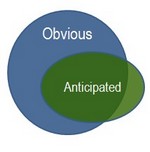

Figure 1 Figure 2
Links:
- http://patentlyo.com/patent/2008/10/nonobvious-yet.html
- http://www.finnegan.com/files/Publication/96c5dafa-fe96-4f24-b6e5-1172ae640ba5/Presentation/PublicationAttachment/c81948b7-039c-4bec-82d3-11dfb8dd620d/08-1029%2010-07-2008.pdf

Hi Manali, well done maintaining a high quality of work. Your blog is always an interesting read, with clearly articulated ideas and thoughtful choice of topics. Well done!
ReplyDeleteI love your diagrams that depict the difference between "anticipated" and "obvious" patents. It is really nice to see it explained in visual terms rather than via pages and pages of text, filled with legal jargon. As Professor Lavian already mentioned, I love reading your posts!
ReplyDelete