Monday, April 7, 2014

Sunday, April 6, 2014
Assignment 9: Blog Post 2: Anticipation versus Nonobviousness
For this blog post,
I decided to discuss an article by Dennis Crouch on patentlyo.com. The case
under review is Cohesive Tech. versus Water Corp. First, a brief background
about this case: This is a patent infringement case, where Cohesive accused
Water's 30 micrometer Oasis HPLC (high performance liquid chromatography)
columns to infringe their '874 patent in the first action and their '368 patent
in the second action. In the third action, Cohesive claimed Water's 25
micrometer Oasis HPLC columns to infringe both patents. Having used HPLC
before, I thought this case was interesting. For those of you who are new to
this field, HPLC is basically a process used to separate, identify, and measure
compounds in a liquid.
In the first action,
the jury decided that the '874 patent was valid and that the HPLC columns
infringed the patent. In the third action, the court was on Water's side (no
infringement). For the first two actions
(regarding the 30 micrometer HPLC column), the district court concluded that
"Waters failed to prove the deceptive intent necessary to sustain its
claim of inequitable product"[2].
The article discusses the idea that novelty
and nonobviousness are "separate and distinct inquiries"[1]. See
figure 1. Dennis Crouch mentions how the Cohesive's
HPLC patent may be obvious, but was not anticipated. Water appealed and
argued that "the judgment was logically incorrect if anticipation truly is
the 'epitome of obviousness'. On appeal, the Federal Circuit confirmed that
novelty and obviousness are separate and distinct-- one does not necessarily follow
the other"[1]. Thus, it is important to realize that the tests for
anticipation and obviousness are different.
The confusion may
arise because it may seem that if there are references in the prior art (what
has already been done before) that anticipate a claim, it will usually mean
that the claim is obvious. However, two circumstances were suggested in which
the anticipated claim may still be nonobvious. The first circumstance is that
secondary considerations of nonobviousness may exist that are not relevant in
the anticipation claim in the prior art. I talked about these secondary
considerations in my previous blog post. The second circumstance suggested by
the court is when "although inherent elements apply in an anticipation,
inherence is generally not applicable to nonobviousness"[1].
The Patentlyo
article had a very good example, that I will copy below, because it really
helps in the understanding this idea:
“Consider, for example, a claim directed toward a
particular alloy of metal. The claimed metal alloy may have all the hallmarks
of a nonobvious invention—there was a long felt but resolved need for an alloy
with the properties of the claimed alloy, others may have tried and failed to
produce such an alloy, and, once disclosed, the claimed alloy may have received
high praise and seen commercial success. Nevertheless, there may be a
centuries-old alchemy textbook that, while not describing any metal alloys,
describes a method that, if practiced precisely, actually produces the claimed
alloy. While the prior art alchemy textbook inherently anticipates the claim
under § 102, the claim may not be said to be obvious under § 103.”
In contrast to
Figure 1, Judge Mayer thinks of the relationship between obviousness and
anticipation more closely to Figure 2, where anticipation is a subset of
nonobviousness. So what do you all think about this distinction between
anticipation and obviousness? Let me know in the comments below.
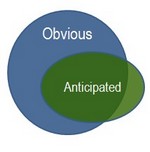

Figure 1 Figure 2
Links:
- http://patentlyo.com/patent/2008/10/nonobvious-yet.html
- http://www.finnegan.com/files/Publication/96c5dafa-fe96-4f24-b6e5-1172ae640ba5/Presentation/PublicationAttachment/c81948b7-039c-4bec-82d3-11dfb8dd620d/08-1029%2010-07-2008.pdf
Assignment 9: Blog Post 1: Obviousness, Graham Factors and Secondary Considerations
It seems that
determining whether or not something is obvious is very subjective. This is why
I feel that the patent system is like an art-- whoever can prove their case the
best wins.
In the Graham versus
John Deere case (1959), the Supreme Court decided that some basic criteria
should first be decided upon: "
- The scope and content of prior art
- The differences between the claimed invention and the prior art.
- The level of ordinary skill in the prior art"
I learned that the
top three criteria are known as Graham Factors, and the Supreme Court utilizes
them as controlling inquiries. The Supreme Court also uses "secondary
considerations" to argue non-obviousness. These considerations include: "
- Commercial Success
- Long-felt but unsolved needs
- Failure of others"
So what is this
supposed to mean? Let's just say a judge thought that a particular claim was
obvious. Again, this is very subjective, and while one judge may think that a
claim is obvious, another judge may not. But even if a specific claim seems
obvious to the examiner, the patentee can turn to the secondary considerations.
He or she "can present evidence that the invention has achieved commercial
success as a definite result of the invention". This suggests that it must
not have been obvious, because if it had been, it would have been done before
(as the need clearly existed). The patentee can present evidence that there was
a long-felt and unsolved need and that
others have tried and failed to solve this problem.
So now, the question
arises of where the patentee can get this evidence and how much evidence is
enough? Evidence can be acquired from the marketplace and from earlier patents
that may talk about the particular need and attempts to solve it. The decision
of whether the evidence is adequate is normally left to the judge.
I wanted to end with
this quote, because I thought was interesting:
"…this question
[regarding obviousness] remains a fairly subjective sandbox- and this is a
sandbox that patent practitioners earn their money in-- because it
sometimes takes concise and strong
arguments to reverse a obviousness rejection"[1].
Links:
Saturday, April 5, 2014
Friday, April 4, 2014
Assignment 8: Extra Credit Blog Post 1: Reading through a Patent
Hi all! So there has
been a lot of talk about patents in general (their purpose, function, etc) ,
and in class, we have read through and analyzed claims for certain patents. I
think this is an extremely important skill and I wanted to practice it myself more.
The patent that I
chose to analyze is titled, "Portable blood filtration devices, systems,
and methods," and can be found in the link below. The reason I chose this patent was that I was
at an event this Wednesday where co-founders of start-ups were pitching their
companies. One co-founder talked about his product, the chemofilter, which is a
catheter based filter that can be placed into a vein that is draining a target
organ (i.e. liver) to be able to trap all the excess toxic chemo drugs before
they go back to the heart and are pumped to the rest of the body. Since this
reduces systemic toxicity, it allows the doctor to deliver a high dose of
chemotherapy. The thing that stood out to me was that the co-founder mentioned
something along the lines of how most patents in the market were for putting
things in the body, and since they were dealing with flow going away from the
organ, they could file a broad patent, which is extremely useful. I also
thought it was interesting how he mentioned this fact in his pitch to a VC,
because it shows how much of an
advantage broad patents can give you.
Okay, now to
analyzing a few claims of this patent. Here are some key points that I learned/
ideas and questions that went through my head:
- The abstract shows that this patent protects a "device, system, and method"[1]. To me, a device and a system are very similar (or perhaps there is a difference?). I also wondered why they didn't have two separate patents-- one for the device and one for the method.
- I also noticed the use of more ambiguous wording, such as "selectively remove or reduce" [1].
- While it is important to define certain aspects of the product, it is also important to keep it general. So for example, they needed to define the unwanted substance that needs to be filtered. However, the patentees did not want to limit themselves in doing so. Thus, they said, "The unwanted substance includes one or more of a pathogen, a toxin, an activated cell, and an administered drug" [1]. Notice how they cannot use words such as "etc." because that is too ambiguous and anything can fall underneath that category.
- There was a "FIELD" section that was one sentence long and basically mentioned that this patent involved "the selective removal of unwanted components" [1]. If I worked at the USPTO and had to read through many patents, this would be a good section for me to come to first when initially sorting through patents.
- There was a "BACKGROUND" section that talked about why this is important. I think this section is good for the general reader, because it mentioned why this product is important, and talked about sepsis (blood infection) that can lead to organ dysfunction, death, and limb amputation. So, why is it important to include a section like this? I think it makes it easier for those who are judging the validity of a patent to see how important or vital it is in the larger scope. Yes, they could have looked up this information themselves online, but most of the jury will not have the motivation to do so. It is important to note that most of the jury, especially in certain courts, are less educated and also less interested. Some people just serve on the jury because it is a requirement for them, and not because they are genuinely interested in the case.
- After reading the claims on the patent, some important aspects are:
- This protects a method for extracorporeal treatment, meaning the blood is filtered outside the body
- To filter, a microfluidic channel is used, and the channel has microsieve wall filters.
- The shape of the microfluidic channel is rectilinear. I thought it was interesting how the dimensions were stated: depth of no more than 200 microns and width of at least 10x the depth. Thus, this patent protects a range of dimensions.
- The removal of unwanted substances can also be done using cascade filtration with multiple membranes of different pore sizes or using an adsorbent.
- I realized many of the claims, especially claims 4 to 13, consisted of filtration methods that already existed, but to make this new, they linked it to the earlier claims, saying "The method of any of the above claims, …" For example, extracting by binding the unwanted substance to an adsorbent has already been done before and is most likely patented.
- At the very beginning of this blog, I mentioned that this patent protects a device, system, and method. While claims 1-14 are all on the method, claim 15 is, "A device configured to implement any of the foregoing methods" and claim 16 is "A system for implementing any of the foregoing methods".
Overall, I think I
am getting slightly better at reading patents, or maybe I just happened to find
this patent not so difficult to decipher. I also think it is a really good
exercise to continue!
Link:
Subscribe to:
Comments (Atom)